Showing posts with label News. Show all posts

SsangYong XIV-2


SsangYong prepared a new concept car called XIV-2 for the Geneva Motor Show, which will be held in early March of 2012. SsangYong XIV-2 leads to a concept vehicle type 'Convertible Crossover,' and was developed from its predecessor, the concept under the name SsangYong XIV-1, which had its presentation at the fall of 2011 on Frankfurt Motor Show. SsangYong developed the concept of the XIV-2 (User Interface Exciting Vehicle 2) as a premium CUV (Crossover Utility Vehicle) and is considered a strategic business model for the global market.

SsangYong XIV-2 will have a movable soft top, which will be operated electrically by pressing just one button. Shape should appeal to young buyers. SsangYong XIV-2 is 4166 mm long, 1820 wide and 1533 mm high with a wheelbase of 2600 mm.  It will be powered by environmentally friendly 1.6-liter petrol and diesel engines and low consumption to meet the Euro 6 emissions standards.

Porsche Macan


Porsche Macan - new, smaller SUV from German factory.

“The Macan combines all sports car characteristics with the benefits of a SUV and is a genuine Porsche”, said Bernhard Maier, Member of the Executive Board Sales and Marketing of Porsche AG. “The name of a new Porsche has to fit with the brand, sound good in very many languages and dialects and evoke positive associations.”


Word names at Porsche have a concrete connection with the corresponding model and its characteristics: the name Boxster describes the combination of boxer engine and roadster, Cayenne stands for sharpness, the Cayman is snappy and agile and a Panamera is more than a Gran Turismo, capable also of winning the Carrera Panamericana long-distance race.

Macan has different meanings in different languages. Most relevant to Porsche, we suspect, is that it’s an Indonesian word for tiger. It’s also an old English Christian name and surname, meaning power or performance which, again, suits Porsche’s needs perfectly. You rarely find Macan used as a forename these days but it remains a reasonably common surname around the world.

The Macan will go on sale in 2013, and is being built at the newly expanded Leipzig facility in Germany, creating over 1000 new jobs there.

KIA KH

KIA has released some sketches of new sedan called KH to prove that they follow all their rivals in design. Small lack of imagination in name, but plenty of the same in design. KH will appear on market till the end of 2012 although in Europe it will be somewhere next year.
There are no certain information about this KIA sedan yet, and it all looks like a mystery for now, but we have some sketches to show you.


Bertone Nuccio Concept

Over the years, the name “Bertone” has graced some truly classic automobiles, including the Alfa Romeo Giulia GT, the Lamborghini Muira, the Lancia Stratos, the Lamborghini Countach and the Ferrari 308.

Despite Giuseppe "Nuccio" Bertone’s death in 1997, the company is still active in automobile design and still producing concept cars. At the upcoming Geneva Motor Show, Bertone will debut its radically styled Nuccio concept, named in honor of its former CEO. Based on the sketches leaked ahead of the show, Car Body Design calls the concept “muscular” and “extreme.”

We agree on both counts, and think the mid-engine, berlinetta sports coupe looks more like something from Hot Wheels than from a major automotive design studio. Bertone says of the design, “an aesthetic phrasing with a strong emotional impact will progress the brand identity into the future.”

As far as we can translate design-speak, that means “the low height and muscular stance of the Nuccio concept honors Bertone designs of the past, while the futuristic styling gives an idea of what to expect from us in the future.”

Bertone celebrates is 100th anniversary in 2012, and the Nuccio concept will feature prominently in the design firm’s celebration. Look for the car to be unveiled at next month’s Geneva Motor Show, before being exhibited in Beijing, China and Turin, Italy later this year.

Ferrari Aliante

We have seen the future of roadsters, and it just might be the Ferrari Aliante. Designed by Arunkumar Shanmugam, the Aliante aims to convey speed through a carbon fiber chassis, transparent bonnet, and 458-inspired headlights.


Volvo Tandem Vehicle

Volvo's Monitoring & Concept Center (VMCC) in California have produced what they believe is a feasible future transport product based upon an inline occupant configuration. The designers at VMCC envisage a sleek two-seat commuter vehicle which uses very little energy and rarely gets caught in traffic.


"Maybe it sounds over-the-horizon, but consumer trend research together with our conceptual design and engineering work shows we could deliver that vehicle before 2010," says VMCC science officer Ichiro Sugioka. "Our competitors should be wary of the stuff we're doing!"

The Tandem concept reflects the attitude the department have to vehicle design, looking forward to potential new ways to travel. Although much smaller and seemingly more delicate than traditional Volvos, the team at VMCC insist they can factor into the Tandem the level of passenger safety expected from the brand.

As Kolit Mendis, structures and safety engineering manager, explains: "We compensated the Tandem's light weight with new occupant restraint concepts designed to handle frontal collisions with heavier vehicles. Also, the central positioning of Tandem occupants leaves ample room on either side to implement structural features mitigating the severity of side impacts. Our technical evidence is that Volvo would have no problem at all in delivering its traditional levels of driver and passenger safety."

Lars Erik Lundin, VMCC general manager, says that for Volvo, meeting the challenge of sustainable mobility is about looking at designs and hybrid technologies (electric drive, alternative fuels, petrol or diesel derivatives) that will provide 'maximized total efficiency of mobility with minimised environmental impact'.
"Our job is exploring the future and doing something really extraordinary," says Lundin. "The Tandem was originally conceived as a vehicle to help solve the specific over-crowding and pollution problems of southern California, but we soon realized it taps into how people work, travel and think almost everywhere in the industrialised world nowadays."

Strategic design chief Doug Frasher believes that the future will involve car buyers changing their thinking from one-car-fits-all to a scenario "where people own different cars for different reasons, just as we have different clothes for different social events, suits for work, and jeans for play".

"We envisage a 'family' matrix of cars, starting with the commuting Tandem, that will spark a new paradigm in mobility, changing the way the world thinks about auto ownership in the same way the Sony Walkman did for the audio industry."

Volvo's thinking thinking is the result of 'ethnographic' research begun in 1998 into past and current trends among various consumer and other audiences, using techniques such as workshops, focus groups and customer panels. "We created a timeline stretching from 1900 until 2010 with the aim of profiling future customers and the world they'd be inhabiting by understanding how trends emerge," said Benny Sommerfeld, business development manager. "The timeline pinpointed likely future values, needs, desires and aspirations."

The VMCC team believe that this type of design approach will become increasingly relevant in the future, with changes in the way people live and travel. Although very much a concept, the Tandem is not simply a design exercise. According to Geza Loczi, VMCC design director, the Tandem is "a real product still in its infancy that needs a lot of molding and tweaking to grow into a full-fledged finished product."


Morgan Aero Coupe

Morgan will premiere three new models at the 2012 Geneva Motor Show. Among them there will be the new 2013 Aero Coupe, which is basically a supercar built for long trips. The Morgan Aero Coupe is based on the GT3 Aero race car and promises to offer, aside from blistering performance, plenty of passenger space and a generous boot. Morgan builds the new Aero Coupe on a stiff aluminum chassis. Its power comes from a 4.8 liter BMW V8 engine, which develops 270kw (367 bhp) or 291kw (390bhp) when equipped with a sports exhaust system. The new Morgan Aero is rated with an output of 490nm (370 lb/ft) of torque. Morgan is
able to deliver the new Aero with both a 6-speed manual and an automatic transmission. The manual version of the 2013 Morgan Aero is rated with a 0-100 km/h (0-62 mph) acceleration time of 4.5 seconds, while the automatic can reach the same magic speed in just 4.2 seconds. Both versions of the 2013 Aero can top 170 mph/273 km/h.

The Morgan Aero Coupe price list will be announced at a later date, and so will its equipment list.


Mercedes Benz Citan

The latest Mercedes-Benz urban delivery van was previewed today and has been dubbed the Citan. The Citan name was revealed at the Mercedes-Benz Design Center in Sindelfingen during a symposium on brand competence and city logistics. The name Citan is a combination of the words “city” and “titan,” thus making it clear that the vehicle is a first-rate specialist for city logistics — one that was specifically developed to meet the tough challenges faced in day-to-day operations.

New van series to boost sales

With the introduction of the new urban delivery vehicle, Mercedes-Benz is adding another production series to its family of vans. The Citan is supplementing the Vario (6.0 to 8.2 tons), Sprinter (3.0 to 5.0 tons), and Vito (2.77 to 3.2 tons) to broaden the range of products in the lower weight classes of the van market, where it will significantly boost sales.

Whereas the small vans segment was still a niche market in the mid-1990s, it has now grown to around 700,000 units in Europe. Mercedes-Benz Vans plans to gain a market share of four to five percent in this segment. Volker Mornhinweg, Head of Mercedes-Benz Vans, is convinced that the Citan will be a big success. “We will take advantage of the trend toward city vans, which our brand will be able to exploit thanks to its attractively priced vehicles and the high quality of our products and services,” says Mornhinweg. “Our typical Mercedes-Benz reliability, 24/7 service, and, last but not least, our great brand image are key selling points as far as our commercial customers are concerned.”

Due to its large number of variants, the new urban delivery van with the star is suited for a broad range of commercial applications. Not only will the Citan be offered as a panel van, a crewbus, and a mixed-use vehicle; it will also be available in a variety of lengths and weights.

The Citan will be launched on the market in fall 2012. The vehicle will be unveiled to the general public for the first time at the IAA Commercial Vehicle Show in Hanover in September.

The Citan — the ideal partner in city traffic

The Citan was developed and tested in line with Mercedes-Benz’ demanding quality standards. The vehicle is correspondingly durable and robust. At the same time, it meets the requirements of customers from the service, sales, and trade sectors, offering them a large cargo space despite the vehicle’s compact dimensions. In addition, the van boasts attributes typical of the brand, such as great quality, economy, safety, excellent handling, as well as high fuel efficiency and correspondingly low CO2 emissions. The drive concept encompasses a broad range of low-emission, fuel-efficient diesel and gasoline engines and includes a BlueEFFICIENCY package. An electric drive version is also being planned.

The Citan’s operation, interior, materials, and workmanship are of the same high quality as in other Mercedes-Benz vans. The new urban delivery van can therefore be justly called the “little brother” of the Sprinter and Vito, to which it is in no way inferior. As is the case with every Mercedes-Benz vehicle, safety plays a big role in the new van, all variants of which come with ESP as standard.

New markets for Mercedes-Benz vans

Mercedes-Benz has greatly expanded its vans business in recent years. In line with the slogan of “Mercedes-Benz Vans goes global,” the brand is not only manufacturing vans in Düsseldorf (Sprinters), Ludwigsfelde (Sprinters and Varios), and Vitoria, Spain (Vitos), but also in the U.S., Argentina, and China.

It is also planning to strengthen its presence in the Russian market through a partnership with GAZ, the leading manufacturer of commercial vehicles in Russia. Over the medium-term, the GAZ factory near Nizhny Novgorod will produce 25,000 Sprinters each year, and do so strictly according to Mercedes-Benz’ quality standards.

Mercedes-Benz already is the undisputed market leader for mid-size and large vans in Western Europe.


Nissan Invitation Concept

Nissan will unveil the new Invitation concept car at the 2012 Geneva motor show. It's a vision of what the company's B-segment tallboy could become. Yes, it's a snapshot of a future Nissan Note.

The Japanese say 'the Invitation concept underlines Nissan's commitment to the compact car segment,' indicating that they aren't going to abandon every conventional bodystyle for another crossover.

The Invitation will join the Micra hatch and Juke compact SUV in the B-segment. Effectively, this will replace the Note.

When will the Nissan Note be replaced?

In spring 2013, in Europe at least.

It's a much less slabby-sided affair than the Note. And take note of the body sculpting; there are swooshes and slashes aplenty, Nissan even naming the scalloped flanks 'the Squash Line'.

Looks a bit like Vauxhall/Opel's scooped-out line on the side of an Astra or Insignia.

Nissan on the new Invitation

François Bancon, deputy division general manager of product strategy and product planning division - that's one helluva of a business card - said: 'The name we have given to this concept is self-explanatory… the key benefit of this compact car is to be inviting.

'It is inviting thanks to its sensuous exterior design and generous and comfortable interior space, cleverly packaged within compact overall dimensions. It is Nissan’s invitation to buyers in the compact hatchback segment.'

The Invitation uses the Renault-Nissan B-segment architecture and Nissan says it is targeting a sub-100g/km CO2 rating.

Big car features will be available, including Nissan's Around View Monitor (its first appearance on a car in this sector).


Mazda Shinari

The Mazda Shinari concept gives us a clear idea as to what the next Mazda 6 will look like. The first vehicle wearing a new Mazda design language dubbed Kodo (“Soul of Motion”), the Shinari concept is a gorgeous, if slightly overblown, four-seat coupe that looks like the lovechild of a Maserati GranTurismo and a Jaguar XF. The cab-rearward proportions; swoopy lines; and giant, 21-inch wheels give the impression that Mazda might be going after the likes of Mercedes, BMW, and Audi.

New chief designer Ikuo Maeda told us that the intention behind his first concept was "to build the car I want to buy and drive." It's his move away from the flowing, nature-inspired Nagare design theme, a softer ethos that resulted in the gaping maw of the current Mazda 3. Kodo is a more expressive philosophy that is meant, Maeda says, to evoke the muscularity of a cheetah in full flight—you may remember that Nissan’s Shiro Nakamura previously used the same animal as inspiration, describing the Infiniti FX as a “bionic cheetah."

The Shinari is based on a new architecture that can be front-, rear-, or all-wheel drive. Further proof of this car’s future 6-ness comes in the confirmation that the concept’s architecture will underpin the next generation of Mazda C- and D-segment vehicles (think Toyota Camry and Honda Accord). We peeked underneath the concept and discovered a 2.0-liter four-cylinder engine (likely one of the company’s new Sky powerplants) driving the front wheels, and a lower-control-arm front-suspension layout.

And so if you push the windshield a bit further forward, remove the goofy concept-car interior, and tone down the wheel size and the front and rear lighting elements, you have the next-gen 6. Even watered down from the Shinari, it's going to be dramatic. And those opposed to the giant smiley face that characterizes current Mazdas should rest easy: The Shinari’s grille and front lighting will define the brand’s vehicles as long as Maeda-san, whose father designed the first RX-7, is in charge.


Bertone Jaguar B99

Famed Italian styling house Bertone has taken it upon itself to pen a special Jaguar sedan, called the B99, for the upcoming Geneva auto show. Bertone says it is pitching the car as a design proposal to Jaguar, with an eye toward the British company re-entering the D-segment against the BMW 3-series and Audi A4. (You may recall that the last Jag  in that segment was the far-from-great X-type.) That said, while Jaguar gave Bertone the blessing to build the B99, it’s nowhere near approval for series production.


The design itself of the B99 is a departure from current Jaguar models, and looks more like an evolution of the XJC coupe of the 1970s—were it being reinterpreted as a mid-1990s concept car. Coming from Bertone, which can lay claim to such forward-looking beauty queens as the Lamborghini Miura and Lancia Stratos, this is a disappointment. Attractive? Sorta’. But it doesn’t represent any radical shifts, as did Jaguar’s XF, and we hope the B99 looks better in the metal at the Geneva show. We’ll know soon enough—the Geneva press days are March 1 and 2, at which point we’ll bring you photos and info live from the show floor.


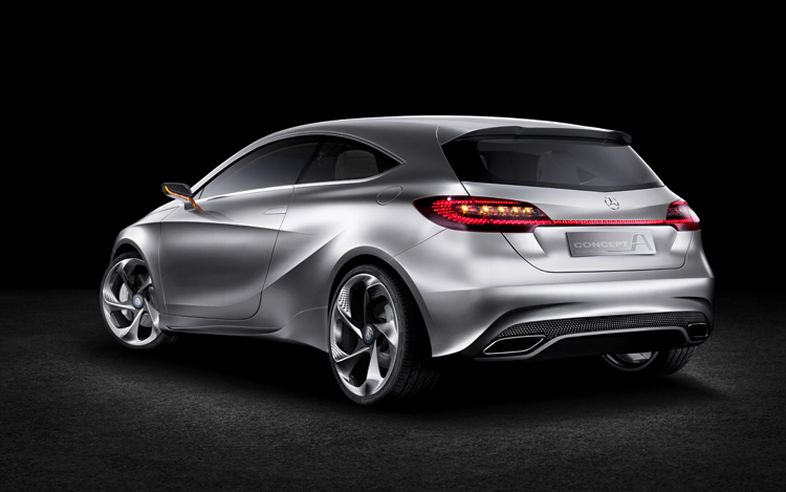
Mercedes Benz A Class Concept


Mercedes' A-Class has historically been a four-door hatchback more concerned with environmentally friendly utilitarian duties than making a statement about style. For the 2011 New York and Shanghai Auto Shows, Mercedes intends to change that frumpy image with an aggressively styled concept that looks more performance hot-hatch than green hipster-hauler, taking the A-Class in an entirely new direction. Thought it is just a concept, it might show the direction the front-wheel drive platform is headed-one that will appeal to a more youthful and enthusiastic buyer.

Looking ready to go head-to-head with the likes of the Audi A3 and Volvo C30, the A-Class Concept is powered by a 210-horsepower 2.0-liter direct-injection turbocharged I-4 mated to a dual-clutch transmission. In hot-hatch tradition, this powertrain is splayed out transversely across the front of the car.
The design language seen on this new A-Class first appeared on another concept, the F800 Style shown at the 2010 Geneva Auto Show. The body consists of free-flowing surfaces accented with sharp creases. Mercedes states that the styling was influenced by wind and waves and reflects aviation engineering. This theme is reflected in the interior, with see-through fabric stretched over a skeletal structure. The vents, instrumentation, and shifter all reflect avionic controls, looking minimalist and very futuristic at the same time.

The A-Class Concept is stuffed with technology. Mercedes boasts of being the first in the compact segment to offer a radar-based collision avoidance system and adaptive brake technology. The system audibly and visually warns inattentive drivers about possible collisions while preparing the braking system for an immediate and powerful stop. Infotainment details are handled by a fully integrated smartphone and use a three-dimensional dash display formed of magenta-colored laser lines. The interior seats four in separate buckets, and one long center console is shared by both the front and rear seats.
Rumors of Mercedes bringing the A-Class to the American market have been brewing for years. It looks like we may be one step closer, but in an entirely unexpected form. Instead of a smallish people-mover, it may very well end up being an upscale performance hatchback. There is even a possibility it may turn into multiple A-Class vehicles. We will get our first look at the concept in New York later this month. Maybe Mercedes will have more information about future plans then.


Alfa Romeo BAT 11 concept


The Alfa Romeo BAT 11 concept from 2008 was a continuation of the B.A.T. line of Bertone concept cars from the 1950s which were characterized by dramatic styling wings. BAT stands for Berlinetta Aerodinamica Tecnica.

The Alfa Romeo BAT 11 was based on the Alfa Romeo 8c Competizione platform. The concept was commissioned by car collector Gary Kaberle who previously owned the Alfa Romeo BAT 9.

One of the more unusual features of the BAT 11 concept, aside from the massive rear wings, were the aerodynamic front wheel covers. These can move during low speed corners to allow for full steering lock. The 21 inch turbine styled wheels featured carbon fibre spokes.


Kia Track'ster


Kia has released a new teaser image of the Track'ster concept, ahead of its debut at the Chicago Auto Show.
Created by the company's California design studio, the concept has LED taillights, a dual exhaust system and a ventilated rear bumper.
Additional information is limited, but the concept is based on the Soul and could preview the next-generation model. Power may be provided by the Hyundai Veloster's turbocharged 1.6-liter four-cylinder engine, with 208 hp (155 kW / 211 PS) and 195 lb-ft (265 Nm) of torque, but nothing is official as of yet.

Suzuki Regina concept

Suzuki has unveiled the new Regina Concept at the Tokyo Motor Show which could represent a new, global compact car for the Japanese brand.
The Regina Concept comes with an 800cc turbocharged petrol engine coupled to a new CVT transmission. The car features regenerative braking and a stop/start system that, along with a curb weight of just 730 kg (1606 lbs), allows it to achieve a fuel-economy rating of 3.76 liters/100 km (75 mpg imperial).
The concept measures 3,500 mm long and 1,600 mm wide and features a new manufacturing process that reduces the number of parts needed and improves rigidity. The interior also features a sloped dashboard to allow more cabin space.
This is one concept that may make production someday as a new minicar in the Suzuki lineup.


                                                                                                                                       Source: Suzuki

Maserati Kubang

Maserati showed a Giugiaro-styled SUV named the Kubang (after a Javan wind) in Detroit in 2003 in response to the then new Porsche Cayenne.

They've kept the name, and the basis of the vehicle will be the Jeep Grand Cherokee, but the engine, suspension, steering and brakes will be Maserati and the Jeep styling makeover has been conducted under the eye of Maserati's Lorenzo Ramaciotti.

The car will also come with a choice of several new Maserati engines designed by ex-Ferrari F1 engine designer Paolo Martinelli, and will be produced in Maranello by Ferrari.

The transmission will be an AT eight-speed auto and the suspension, brakes and steering components will also be developed in Modena by the Maserati Product Development Department.

The Kubang is still expected to be built in Detroit as per the article earlier in the week.

Interestingly, the original Kubang was to be powered by a Chrysler Hemi V8.